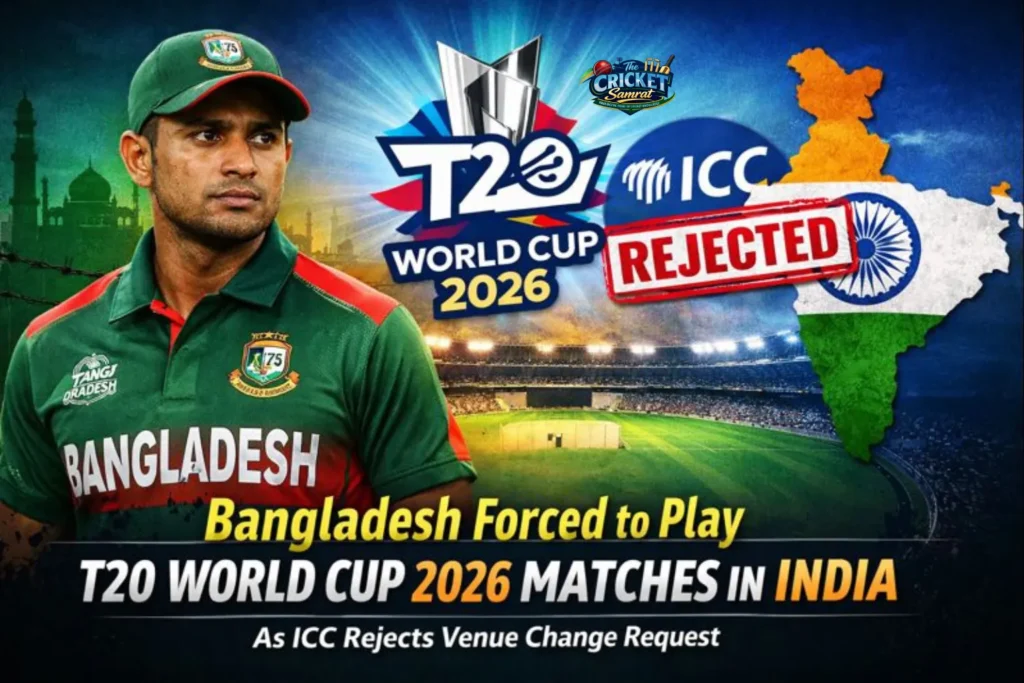
Bcb request icc: The International Cricket Council (ICC) has firmly rejected a request from the Bangladesh Cricket Board (BCB) to relocate Bangladesh’s T20 World Cup matches away from India, making it clear that the team must honour the original tournament schedule or face strict consequences. The decision follows growing tensions triggered by political, security, and sporting disputes involving Bangladesh, India, and the Indian Premier League (IPL).
According to senior ICC officials, Bangladesh will be required to play all its scheduled group-stage matches of the T20 World Cup in India. Failure to do so could result in points deductions, disciplinary action, or further sanctions under ICC tournament regulations. The ruling comes after what sources describe as a “formal but unsuccessful” Bcb request icc to move matches to Sri Lanka, citing safety concerns following recent developments surrounding Bangladeshi fast bowler Mustafizur Rahman.
ICC Takes a Firm Stand on Tournament Integrity
The ICC’s stance underscores its long-standing policy of maintaining tournament integrity and avoiding last-minute venue changes unless exceptional circumstances arise. After a series of internal meetings in Mumbai, ICC Chairman Jay Shah and other senior officials concluded that Bangladesh’s concerns did not meet the threshold required for altering a World Cup schedule that has been planned years in advance.
Officials familiar with the discussions said the ICC first held consultations with the Board of Control for Cricket in India (BCCI) before engaging directly with representatives of the Bangladesh Cricket Board. Despite listening to BCB’s concerns, the ICC ultimately ruled that no changes would be made.
An ICC source told reporters that the governing body had “clearly communicated” to Bangladesh that participation in the tournament is mandatory as per the agreed schedule. “If any team refuses to play its assigned matches, tournament rules allow the ICC to award points to the opposition or impose penalties,” the official said.
Roots of the Dispute: The Mustafizur Rahman Controversy
At the centre of the controversy lies Bangladesh pacer Mustafizur Rahman and his short-lived association with Kolkata Knight Riders (KKR) in the IPL. During the IPL mini-auction held on December 16, KKR purchased Mustafizur for a reported ₹9.20 crore, marking one of the most high-profile signings of the auction.
However, soon after the announcement, protests erupted in parts of India following reports of violence against Hindu minorities in Bangladesh. The situation escalated when news emerged that at least six Hindu individuals had been killed in separate incidents, sparking outrage among certain groups in India.
As tensions mounted, security concerns were raised regarding Mustafizur’s participation in the IPL. The BCCI eventually decided not to grant clearance for the Bangladeshi bowler to take part in the tournament. On January 3, Kolkata Knight Riders officially released Mustafizur from their squad, citing regulatory and logistical challenges.
Bangladesh Reacts Strongly: IPL Broadcast Ban Imposed
The release of Mustafizur triggered a strong reaction from Bangladesh. In what appeared to be a retaliatory move, the Bangladeshi government, in coordination with the Bangladesh Cricket Board, imposed a ban on the broadcast of the Indian Premier League across the country.
Bangladesh’s Ministry of Information and Broadcasting issued formal directives instructing television networks and digital platforms not to air IPL matches. The notification specifically referenced the decision to exclude Mustafizur Rahman from KKR and expressed dissatisfaction with how the situation had been handled by Indian cricket authorities.
Shortly after the broadcast ban, BCB escalated the matter by formally approaching the ICC, arguing that the same security concerns affecting IPL participation could also impact Bangladesh’s safety during the T20 World Cup in India. The Bcb request icc sought permission to shift Bangladesh’s matches to Sri Lanka, a neutral venue with recent experience hosting international tournaments.
ICC Rejects Venue Shift, Warns of Point Deductions
Despite the diplomatic outreach, the ICC was unmoved. Officials reiterated that security arrangements in India meet international standards and that multiple teams are participating without objections. The governing body also stressed that allowing one team to shift venues could set a dangerous precedent for future tournaments.
“The ICC has invested heavily in planning and logistics,” a senior administrator explained. “Moving matches at this stage would disrupt broadcast schedules, ticketing, team travel, and fan engagement.”
As per ICC tournament regulations, a team refusing to play scheduled matches without valid justification may forfeit points. In a group-stage format, such forfeitures could severely damage Bangladesh’s chances of qualifying for the knockout rounds.
Bangladesh’s Group Stage Schedule Remains Unchanged
Bangladesh has been placed in Group C of the T20 World Cup, alongside West Indies, Italy, England, and Nepal. All group-stage matches were confirmed months ago and remain unchanged despite the controversy.
The schedule is as follows:
- February 7: Bangladesh vs West Indies – Eden Gardens, Kolkata
- February 9: Bangladesh vs Italy – Eden Gardens, Kolkata
- February 14: Bangladesh vs England – Eden Gardens, Kolkata
- February 17: Bangladesh vs Nepal – Mumbai
Eden Gardens, one of cricket’s most iconic venues, is set to host Bangladesh’s first three matches, while the final group fixture will take place in Mumbai. ICC officials emphasized that these venues have successfully hosted major international events with robust security protocols.
Pakistan’s Situation Highlights Diplomatic Complexity
The Bangladesh issue has drawn comparisons with Pakistan’s decision to shift its T20 World Cup matches to Sri Lanka. However, ICC insiders clarified that the two cases are fundamentally different.
Pakistan’s relocation was negotiated well in advance due to long-standing political tensions between India and Pakistan. Both nations have not played bilateral cricket on each other’s soil for years, and India itself declined to travel to Pakistan for the Champions Trophy last year.
As a compromise, Pakistan’s matches — including the high-profile India vs Pakistan clash — were moved to Colombo, Sri Lanka. The ICC considers this a unique arrangement shaped by decades of diplomatic complexities rather than a precedent applicable to other teams.
Bangladesh Faces Pressure from All Sides
Within Bangladesh, the situation has sparked intense debate. While some officials support a firm stance against India, others worry that withdrawing from World Cup matches could harm Bangladesh cricket’s global standing.
Former players and analysts have urged the BCB to prioritise cricket over politics. “The World Cup is the pinnacle of the sport,” a former Bangladesh captain said in a local television interview. “Missing matches or losing points without playing would be disastrous for the team and the fans.”
Sponsors and broadcasters are also reportedly uneasy. Bangladesh’s participation in the World Cup guarantees global exposure, revenue, and commercial partnerships. Any disruption could result in financial losses and strained relationships with international stakeholders.
ICC Emphasises Neutral Governance
In response to criticism, the ICC reiterated its role as a neutral governing body. Officials stressed that decisions are made based on cricketing considerations, safety assessments, and contractual obligations — not political pressure.
“We understand the sensitivities involved,” an ICC spokesperson said. “However, the ICC cannot allow individual disputes to undermine the structure of a global tournament.”
The spokesperson added that security agencies in India have provided detailed assurances regarding team safety, hotel arrangements, travel logistics, and stadium security.
What Lies Ahead for Bangladesh?
With the tournament fast approaching, Bangladesh now faces a critical decision. Accepting the ICC ruling would allow the team to compete normally, while refusal could see them lose points or even face disciplinary action.
Cricket experts believe the BCB will ultimately comply. “Walking away from a World Cup is not realistic,” said a UK-based cricket analyst. “The damage would far outweigh any political statement.”
As of now, Bangladesh has not issued a final response following the ICC’s rejection of the Bcb request icc. However, preparations for the tournament are continuing, and players are expected to assemble according to the original schedule.
Conclusion: Cricket Caught Between Sport and Politics
The standoff between the Bangladesh Cricket Board and the ICC highlights how modern cricket often intersects with politics, diplomacy, and public sentiment. While Bangladesh’s frustration over the Mustafizur Rahman episode is evident, the ICC’s decision reinforces the principle that global tournaments must remain insulated from bilateral disputes.
With the T20 World Cup set to captivate fans worldwide, all eyes will now be on Bangladesh’s next move -and whether the team will take the field in India as scheduled or risk severe consequences by staying away.
For now, the message from the ICC is unambiguous: the World Cup will proceed as planned, and Bangladesh must play in India or pay the price.