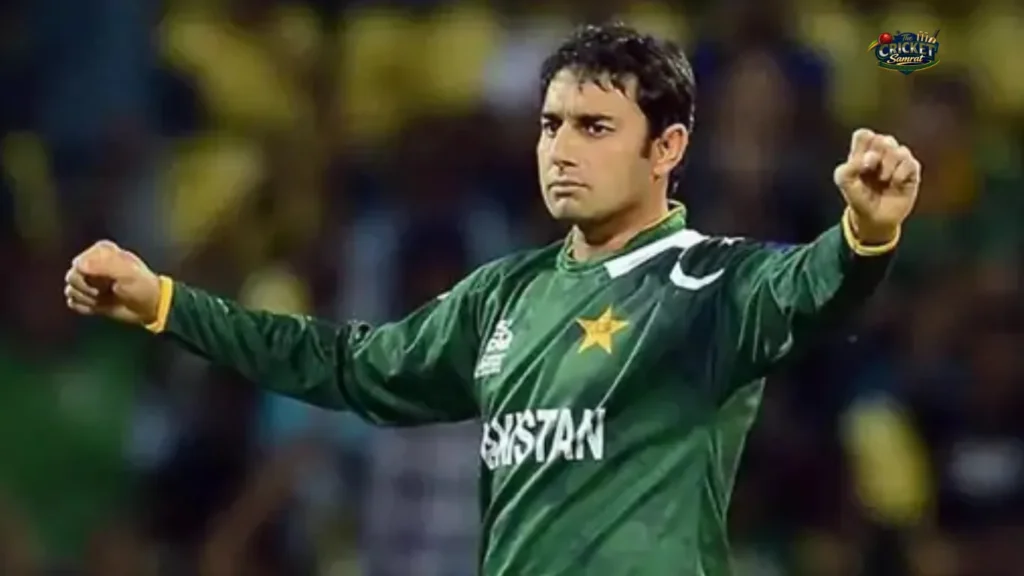
The long-standing tensions surrounding power dynamics in world cricket have resurfaced once again, with the International Cricket Council (ICC) finding itself at the centre of fresh controversy. This time, the criticism has come from Pakistan’s former off-spinner Saeed Ajmal, who has openly questioned the relevance and independence of the global governing body, alleging that it operates under the overwhelming influence of the Board of Control for Cricket in India (BCCI).
Ajmal’s explosive remarks have sparked heated debate across the cricketing world, particularly in Pakistan, where frustration has been building over what many perceive as India’s dominant position in international cricket governance. His comments follow closely on the heels of similar statements made by former Pakistan captain Shahid Afridi, indicating a growing chorus of discontent among ex-Pakistani cricketers.
Background: Bangladesh–India Venue Dispute Triggers Fresh Debate
The latest controversy emerged amid reports that the ICC rejected a request from the Bangladesh Cricket Board (BCB) to shift their scheduled match against India in the ICC Men’s T20 World Cup 2026 from India to Sri Lanka. Bangladesh had reportedly sought the venue change due to concerns surrounding logistics and competitive balance, but the ICC is understood to have dismissed the proposal.
This decision reignited discussions about the extent of BCCI’s influence within the ICC, with critics arguing that India’s preferences routinely carry greater weight than those of other cricketing nations. Saeed Ajmal seized upon this moment to deliver a blistering critique of the global cricket administration.
Saeed Ajmal Questions ICC’s Very Existence
Speaking to the media, the former Pakistan spinner did not mince words. Ajmal asserted that the ICC has lost its authority and purpose, claiming that it no longer functions as an independent body safeguarding the interests of world cricket.
“If the ICC cannot enforce its decisions on the Indian board, then its existence is meaningless,” Ajmal said, directly questioning the governing council’s credibility.
According to him, the ICC’s repeated reluctance to challenge the BCCI has gradually eroded trust in its neutrality. Ajmal warned that if the ICC continues to operate under the shadow of the Indian cricket board, it risks becoming irrelevant in the long run.
Allegations of Selective Governance
Ajmal pointed to several instances that, in his view, highlight the ICC’s double standards. One of the most prominent examples he cited was India’s continued refusal to tour Pakistan, even for major ICC tournaments, despite Pakistan hosting international cricket successfully in recent years.
“India has no logical reason not to play in Pakistan, especially in global events,” Ajmal claimed. “Yet the ICC accepts this stance without resistance. This clearly shows who holds the real power.”
The former off-spinner argued that while the ICC strictly enforces regulations on smaller or less influential cricketing nations, it hesitates to impose similar pressure on India. This imbalance, he said, exposes a deeper structural problem within international cricket administration.
“ICC Is Helpless Because of India’s Dominance”
In one of his strongest remarks, Ajmal stated that the ICC is effectively “helpless” due to India’s dominance in world cricket, both commercially and politically.
“India’s control over global cricket has made the ICC weak,” he said. “The council does not exercise the same authority over India that it does over other Test-playing nations.”
According to Ajmal, many cricket boards privately share this sentiment but choose not to speak out publicly due to financial dependencies and fear of diplomatic consequences. He suggested that the BCCI’s economic clout—driven by India’s massive television market and sponsorship revenues—has given it unparalleled leverage over decision-making at the ICC level.
India–Pakistan Cricket: Politics, Security, and Neutral Venues
The strained cricketing relationship between India and Pakistan has been shaped by political tensions and security concerns for more than a decade. India has not toured Pakistan since 2008, citing safety reasons, while the Indian government has also refused permission for bilateral series between the two nations.
As a result, India and Pakistan now face each other only in multi-nation tournaments, and even then, matches are played exclusively at neutral venues. While Pakistan has successfully hosted teams from Australia, England, New Zealand, and South Africa in recent years, India’s stance remains unchanged.
Ajmal believes this selective participation undermines the principle of fairness that the ICC is meant to uphold, and he argues that the BCCI’s influence allows India to dictate terms without facing consequences.
Ajmal’s Own History With the ICC
Interestingly, Ajmal’s criticism of the ICC also revives memories of his own turbulent history with the governing body. In 2014, the ICC imposed a ban on Ajmal from international cricket after ruling that his bowling action was illegal.
The issue surfaced during Pakistan’s Test match against Sri Lanka in Galle, where match officials reported concerns about his action. A subsequent biomechanical assessment conducted in Brisbane, Australia, revealed that Ajmal’s elbow extension exceeded the permitted 15-degree limit by a significant margin.
At the time of the ban, Ajmal was ranked the world’s number-one ODI bowler, making the suspension a massive blow to Pakistan cricket. Although he later remodelled his bowling action and attempted a comeback, he was never able to replicate his previous effectiveness and eventually announced his retirement.
While Ajmal did not directly link his ban to institutional bias, critics have noted that his strained relationship with the ICC adds another layer of complexity to his current remarks.
India vs Pakistan Set for High-Profile Clash in T20 World Cup 2026
Despite the political and administrative tensions, cricket fans worldwide are eagerly awaiting the next chapter in the sport’s fiercest rivalry. India and Pakistan are scheduled to face each other in the ICC Men’s T20 World Cup 2026, which begins on 7 February.
Their highly anticipated group-stage match will take place on 15 February in Colombo, Sri Lanka, a neutral venue chosen to accommodate both teams. The fixture is expected to be one of the most-watched matches of the tournament, drawing massive global television audiences.
Historically, India has enjoyed a clear edge over Pakistan in T20 World Cup encounters. Pakistan has managed just one victory against India in the tournament’s history, while India has dominated most meetings with clinical consistency.
India’s Group Fixtures at T20 World Cup 2026
India’s group-stage schedule for the tournament is as follows:
- 7 February – India vs USA, Mumbai
- 12 February – India vs Namibia, Delhi
- 15 February – India vs Pakistan, Colombo
- 18 February – India vs Netherlands, Ahmedabad
If both India and Pakistan progress to the knockout rounds, fans could witness another blockbuster showdown later in the tournament.
Also read: WPL First Century Player Name: Complete Story of the Historic Moment in Women’s Premier League
Broader Implications for World Cricket
Ajmal’s remarks have once again highlighted a debate that has been simmering beneath the surface of world cricket for years: whether the ICC can truly function as an impartial regulator in an era where financial power heavily influences governance.
The BCCI’s role as the wealthiest and most powerful cricket board is undisputed. Its commercial strength has undeniably contributed to the global growth of the sport, but critics argue that this dominance has come at the cost of competitive and administrative balance.
Whether or not one agrees with Saeed Ajmal’s outspoken views, his comments have reignited an uncomfortable conversation for the ICC—one that raises serious questions about transparency, equality, and the future structure of global cricket governance.
As the T20 World Cup 2026 approaches, the spotlight will not only be on the players and matches but also on the institutions that govern the game. And once again, the influence of the BCCI will remain central to that discussion.