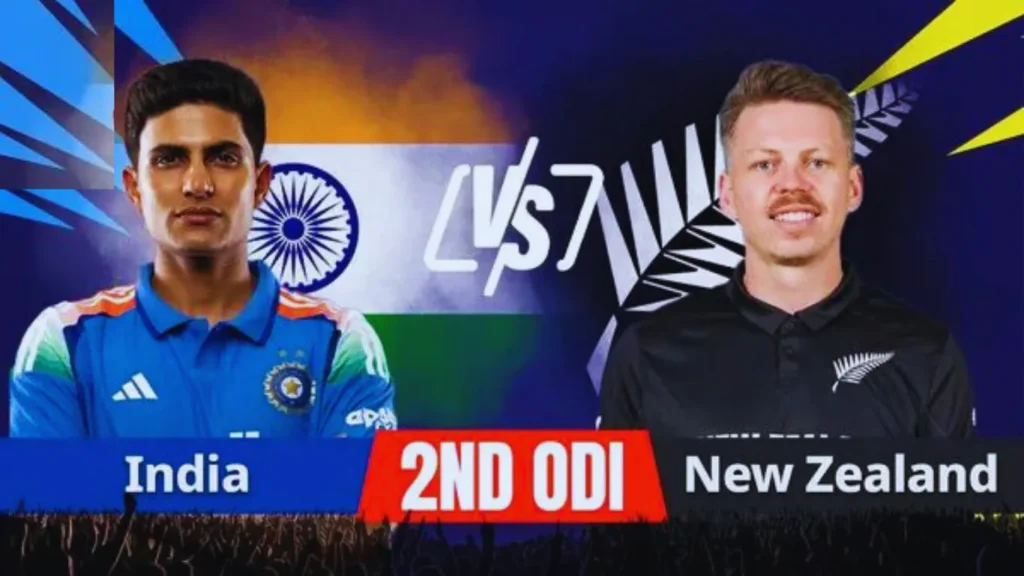
Rajkot witnessed a gripping chapter in the ongoing India vs New Zealand One-Day International series as the visitors produced a commanding performance to defeat India by seven wickets in the second ODI at the Niranjan Shah Stadium on Wednesday. Chasing a competitive target of 285, New Zealand scripted their highest-ever successful run chase on Indian soil, reaching the target in just 47.3 overs with three wickets to spare. The emphatic victory not only showcased New Zealand’s growing confidence in subcontinental conditions but also brought the three-match series level at 1-1, setting up a high-stakes decider in Indore.
At the heart of New Zealand’s triumph was a sublime unbeaten century from Daryl Mitchell, whose calm authority and flawless shot selection dismantled India’s bowling attack. Mitchell remained unbeaten on 131 off 117 balls, peppering the boundary with 11 fours and two sixes in an innings that will be remembered as one of his finest in ODIs. He was ably supported by opener Will Young, who struck a fluent 87, as the duo laid the foundation for a chase that never truly lost momentum.
A Crucial Toss and a Strong Indian Start
The match began with New Zealand captain Michael Bracewell winning the toss and opting to field first, a decision influenced by the Rajkot pitch’s reputation for being batting-friendly under lights. India, asked to bat first, started cautiously but confidently, with Rohit Sharma and captain Shubman Gill negotiating the early movement on offer.
Despite a maiden opening over from Kyle Jamieson, India gradually settled. Rohit Sharma, after playing out ten dot balls, opened his account with a single and soon followed it up with a couple of crisp boundaries. Gill, meanwhile, looked fluent from the outset, timing the ball sweetly through the covers and midwicket.
The Indian openers ensured a wicketless powerplay, taking India to 57 without loss after 10 overs. Their partnership crossed fifty in the ninth over, underlining a solid platform for a big total.
However, New Zealand struck back in the 13th over when Christian Clarke dismissed Rohit Sharma for 24, breaking a 70-run opening stand. Rohit was caught by Will Young, ending a steady knock that promised more.
Gill’s Fifty and Clarke’s Double Blow
Shubman Gill continued to anchor the innings, bringing up his half-century with a well-timed boundary. His innings of 56 was composed and mature, but it ended in the 17th over when Kyle Jamieson had him caught by Daryl Mitchell. India reached the 100-run mark in the same over but lost their captain at a critical juncture.
Christian Clarke then turned the game sharply in New Zealand’s favour. He first removed Shreyas Iyer for eight and followed it up by bowling Virat Kohli for 23 in the 24th over. Kohli’s dismissal was significant, but even in his brief stay, the former Indian captain achieved a major milestone.
Kohli Breaks Another Tendulkar Record
During his 23-run innings, Virat Kohli surpassed Sachin Tendulkar to become the highest run-scoring Indian batter against New Zealand in ODI cricket. Kohli now has 1,773 runs against the Black Caps, overtaking Tendulkar’s tally of 1,750. Overall, Australia’s Ricky Ponting remains the leading run-scorer against New Zealand with 1,971 runs.
Kohli’s dismissal left India at 142 for four after 30 overs, with momentum swinging firmly towards the visitors.
KL Rahul and Ravindra Jadeja Rebuild
With India wobbling, KL Rahul and Ravindra Jadeja stitched together a crucial partnership that rescued the innings. The duo played sensibly, rotating the strike and punishing loose deliveries. Their fifth-wicket stand crossed fifty in the 36th over, providing India with much-needed stability.
Rahul brought up his half-century off 52 balls, displaying a perfect blend of caution and aggression. Jadeja, playing the role of a support act, contributed a valuable 27 before being dismissed by Michael Bracewell, who produced a sharp caught-and-bowled effort to break the 73-run stand.
Rahul’s Historic Century Lifts India to 284
After Jadeja’s departure, Rahul took full control of the innings. He continued to find boundaries in the death overs, ensuring India crossed the 250-run mark despite losing wickets at the other end. Nitish Kumar Reddy scored 20 before falling, while Harshit Rana managed just two.
In the final over, Rahul showcased his class by striking two boundaries, finishing unbeaten on 112 off 92 balls. It was his eighth ODI century and one of his most significant knocks under pressure, guiding India to a respectable total of 284 for seven.
This century also etched Rahul’s name into the record books.
KL Rahul Creates Unique ODI Record
With his century against New Zealand, KL Rahul became the first batter in the history of ODI cricket to score centuries at every batting position from No.1 to No.6. This remarkable feat underlined his versatility and adaptability across formats and roles, cementing his reputation as one of modern cricket’s most flexible batters.
New Zealand’s Chase Begins with Caution
Chasing 285, New Zealand adopted a measured approach. Devon Conway and Henry Nicholls opened the innings, negotiating the early overs carefully. Mohammed Siraj conceded six runs in the first over, but Harshit Rana soon made an impact.
In the sixth over, Rana dismissed Conway for 16 with a well-directed outswinger that clipped the stumps. Kyle Jamieson had earlier bowled a maiden, and Rana followed it up with another tight over, maintaining pressure on the New Zealand top order.
Nicholls and Will Young guided New Zealand to 34 for one at the end of the powerplay, ensuring no further damage.
Middle Overs: Young and Mitchell Take Charge
Nicholls’ resistance ended in the 13th over when Prasidh Krishna bowled him for 10 with a short-pitched delivery that took an edge onto the stumps. At that point, New Zealand were 50 for two.
From there, the match turned decisively. Will Young and Daryl Mitchell came together and built the innings brick by brick. The pair brought up a fifty-run partnership in the 21st over and took New Zealand past 100 in the 22nd.
Young reached his half-century off 68 balls, ending a run of low scores across formats. Mitchell followed with a fifty of his own off just 52 balls, his second consecutive half-century in the series after scoring 84 in the first ODI.
Missed Chances Cost India Dearly
India’s bowlers struggled to break the partnership, and when opportunities came, they were not taken. In the 36th over, Prasidh Krishna dropped Daryl Mitchell on 82, a moment that proved pivotal. Mitchell capitalised immediately, pushing the partnership past 150 in the same over.
Will Young eventually fell for 87 in the 38th over, caught by Nitish Kumar Reddy off Kuldeep Yadav, ending a massive 162-run stand. But by then, the damage had been done.
Mitchell’s Century and the Final Push
Daryl Mitchell brought up his eighth ODI century in the 42nd over, reaching the landmark in 96 balls with a single. He remained composed even as the target neared, finding gaps with ease and punishing any lapse in line or length.
New Zealand crossed 250 in the 44th over, needing just 33 more runs with Mitchell firmly set. Alongside Glenn Phillips, Mitchell added a brisk partnership, with the pair bringing up a fifty-run stand in the 45th over.
The winning runs came in the 48th over, as New Zealand completed the chase at 285 for three, sealing a historic seven-wicket victory.
New Zealand’s Biggest ODI Chase in India
This successful pursuit was New Zealand’s highest-ever run chase in ODI cricket on Indian soil, underlining the significance of the win. It also challenged the long-held notion that New Zealand struggle in subcontinental conditions.
Series Level, Decider Awaits in Indore
With this result, the India vs New Zealand ODI series now stands level at 1-1. The third and final match will be played on January 18 at the Holkar Stadium in Indore, where both teams will aim to clinch the series.
Playing XIs
India:
Shubman Gill (captain), Rohit Sharma, Virat Kohli, Shreyas Iyer, KL Rahul (wicketkeeper), Ravindra Jadeja, Nitish Kumar Reddy, Kuldeep Yadav, Harshit Rana, Mohammed Siraj, Arshdeep Singh.
New Zealand:
Michael Bracewell (captain), Devon Conway, Will Young, Henry Nicholls, Daryl Mitchell, Glenn Phillips, Mitch Hay (wicketkeeper), Jack Foulkes, Kyle Jamieson, Christian Clarke, Jaiden Lennox.
Also read: Alyssa Healy Announces Retirement from International Cricket After India Home Series
Rajkot Conditions and Historical Context
The Niranjan Shah Stadium is known for its batting-friendly surface, though bowlers can find assistance with disciplined lines. Interestingly, India’s ODI record at this venue has been less than impressive. Prior to this match, India had lost three of the four ODIs played here, with the team batting first winning every time.
Weather conditions were ideal for cricket, with clear skies and temperatures ranging between 13 and 28 degrees Celsius. Dew was not a major factor, but the cool evening did add pace to the surface, aiding stroke play.
Head-to-Head and Series Background
This was the 121st ODI between India and New Zealand. India have won 63 matches, while New Zealand have claimed 50 victories. Seven matches ended without a result, and one was tied in 2014.
Despite their overall struggles in India, New Zealand have shown resilience in this series. Historically, among teams that have played at least 20 ODIs in India, New Zealand have the poorest record, with just eight wins in 41 matches. However, this win in Rajkot could mark a turning point.
Also read: Virat Kohli Reclaims ICC No.1 ODI Batsman Ranking After Five Years as Rohit Sharma Slips to Third
What Lies Ahead
As the India vs New Zealand series heads to Indore for the decider, both teams have plenty to play for. India will look to tighten their bowling and fielding, areas that let them down in Rajkot. New Zealand, buoyed by confidence, will aim to carry forward their momentum and clinch a memorable series win on Indian soil.
With individual milestones, record-breaking performances, and a series on the line, the final ODI promises to be a fitting climax to a fiercely contested contest between two of world cricket’s strongest sides.