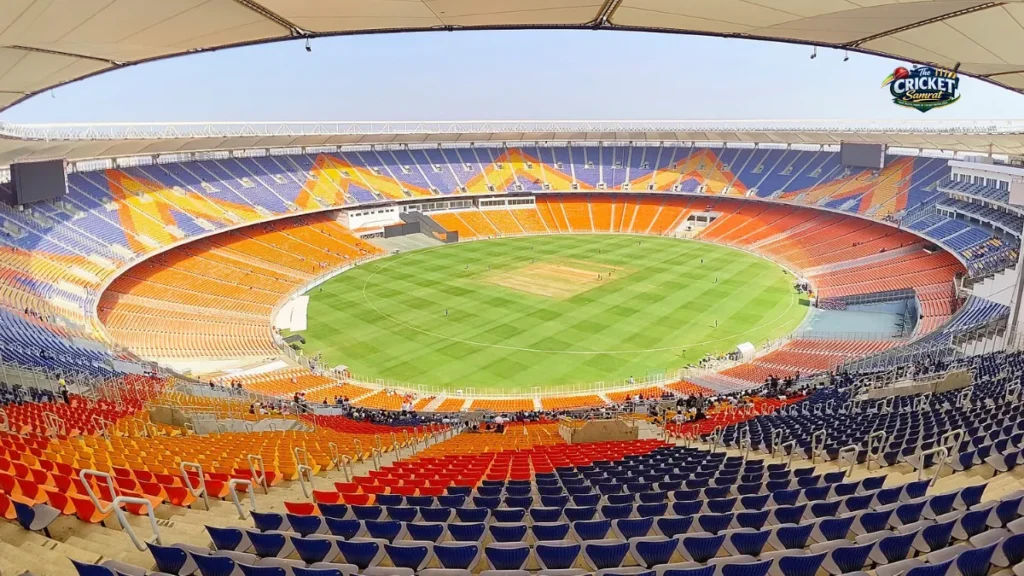
The Narendra Modi Stadium Pitch Report has emerged as one of the most scrutinized and debated topics in Indian cricket. Located in Ahmedabad, Gujarat, this iconic stadium is not only the largest cricket venue in the world but also one of the most versatile in terms of pitch conditions. With a staggering seating capacity of 132,000, the stadium has witnessed countless memorable cricketing moments and continues to be a crucial venue for both international matches and the Indian Premier League (IPL). Beyond its sheer size and modern facilities, the Narendra Modi Stadium has earned a reputation for its pitch diversity, which can favor batsmen, pacers, or spinners depending on preparation and weather conditions.
This comprehensive Narendra Modi Stadium Pitch Report delves into the ground’s characteristics, soil types, historical performances, and strategic insights for teams planning to play here. Whether it’s a Test, ODI, T20, or IPL fixture, understanding the pitch behavior is critical for captains and players alike.
Stadium Overview

The Narendra Modi Stadium, formerly known as Motera Stadium, was renovated and reopened in 2020. It has since become a global cricketing landmark due to its size, facilities, and pitch versatility. Here’s a detailed overview:
| Attribute | Details |
|---|---|
| Location | Ahmedabad, Gujarat, India |
| Capacity | 1,32,000 (largest in the world) |
| Established | Renovated and reopened in 2020 |
| Primary Uses | Test matches, One Day Internationals (ODIs), T20Is, IPL matches |
| Outfield | Fast, supporting quick scoring |
| Boundary Size | Large boundaries, but quick outfield favors runs |
| Pitch Types | Red soil and black soil pitches prepared according to format |
The stadium’s outfield is known for its speed, allowing well-timed shots to race to the boundary. Large boundaries combined with a rapid outfield create exciting scoring opportunities, especially in limited-overs cricket. The pitch type is adjusted depending on the match format, offering a balanced contest between bat and ball.
Pitch Behavior Across Formats
Understanding how the pitch behaves in different match formats is critical for teams. The Narendra Modi Stadium Pitch Report highlights how conditions change from the early phase to the latter stage of matches:
| Format | Early Phase | Mid-Game | Later Stage |
|---|---|---|---|
| Test Matches | Bounce and seam for pacers when grass or moisture is present | Flattens, favoring batsmen on Day 1 and Day 2 | Cracks appear, spinners dominate from Day 3 onwards |
| ODIs | Batting-friendly, especially in the first innings; good bounce for stroke play | Spinners play a crucial role in the middle overs | Dew in the second innings aids chasing teams |
| T20 Matches/IPL | Flat pitch with consistent bounce; ideal for stroke makers | Spinners may gain grip in middle overs | High scores common in death overs; dew assists batters |
Key Insights:
- In Test matches, the early overs are often dominated by pacers exploiting the grass and moisture. As the pitch wears, spinners take over, making the latter part of the game challenging for batsmen.
- ODIs at this venue generally start in a batting-friendly manner, but spinners become decisive during the middle overs. Dew plays a significant role in aiding teams chasing totals in the second innings.
- T20 and IPL matches witness high-scoring contests due to flat tracks and fast outfields. Variations and spinners are crucial in middle and death overs to control the game.
Soil Types and Their Impact
The Narendra Modi Stadium features two primary soil types for pitch preparation: red soil and black soil. Each has unique characteristics that significantly influence match outcomes.
| Soil Type | Characteristics | Impact on Match |
|---|---|---|
| Red Soil | Provides more bounce and pace | Pacers and spinners benefit early; cracks create spin-friendly conditions |
| Black Soil | Retains moisture longer; slower surface | Spin-friendly; favors batsmen who rotate the strike efficiently |
Analysis:
- Red soil pitches are often used for white-ball games, including ODIs and T20s, due to their ability to support high-scoring matches with consistent bounce.
- Black soil tracks are generally preferred for Tests as they retain moisture, slow the ball, and assist spinners once cracks appear on the surface.
Selecting the right soil is critical for curators to influence match dynamics. For instance, an IPL match on red soil often leads to explosive batting, whereas a Test match on black soil can favor bowlers, especially spinners.
Factors Influencing Pitch Behavior
Several external factors influence pitch performance at the Narendra Modi Stadium. Understanding these helps teams strategize effectively.
- Weather Conditions
- Dry and Hot Weather: Accelerates cracking of the surface, making it conducive for spinners in later stages.
- Overcast Conditions: Aid seamers with swing and bounce during early overs.
- Dew
- Evening matches often experience heavy dew, making it difficult for bowlers to grip the ball, favoring batting teams, especially in limited-overs cricket.
- Pitch Preparation
- Curators modify grass cover and rolling intensity based on match format. For Tests, more grass may be retained to aid seamers initially, while flat, dry pitches are preferred for T20s.
- Ground Dimensions
- Large boundaries combined with a fast outfield enable aggressive batting while maintaining a fair contest for bowlers with variations and spin.
Historical Performance Trends
The Narendra Modi Stadium Pitch Report also relies heavily on historical data to predict trends. Examining past matches provides insights into scoring patterns and results.
| Format | Matches Hosted | Batting First Wins | Chasing Wins | Draw/No Result |
|---|---|---|---|---|
| Tests | 15+ | Teams batting first often dominate | Rarely successful chases | Draws common if pitch remains flat |
| ODIs | 25+ | Balanced outcomes | Slight edge for teams chasing due to dew | Few |
| T20Is/IPL | 40+ | High scores common; 170+ par | Chasing favored in IPL | – |
Observations:
- Test matches show a clear advantage for teams batting first. Spinners often control the latter days of a Test, making chasing difficult.
- ODIs feature competitive totals, but teams chasing benefit from dew in the second innings.
- In T20s and IPL, 200+ scores are now common, highlighting the batting-friendly nature of the surface.
Notable Recent Matches
- IPL 2023 & 2024:
Multiple games produced 200+ totals, underscoring the pitch’s flat nature and suitability for power-hitters. - Test Matches Against England (2021):
Pitches were prepared to favor spinners, resulting in slow scoring and low overall totals. This demonstrated the versatility of the stadium, as curators could engineer conditions to suit different strategies. - World Cup 2023:
The stadium hosted both high-scoring batting-friendly games and balanced contests, providing opportunities for both batsmen and bowlers to influence results.
Strategies for Teams
Batting Teams
- Utilize powerplay overs efficiently in white-ball formats.
- Establish partnerships early in Tests before cracks appear on black soil pitches.
- Rotate strike effectively, especially on spin-friendly tracks.
- Adapt to dew conditions during evening matches to maximize scoring opportunities.
Bowling Teams
- Pacers should exploit swing and bounce early, particularly with the new ball.
- Spinners must be introduced strategically in the middle overs to control the game.
- Variations such as slower balls, yorkers, and off-cutters are essential during T20 death overs.
- Understanding the soil type helps determine bowling line and length for maximum impact.
Narendra Modi Stadium Pitch Report – Summary Table
| Aspect | Batting | Bowling |
|---|---|---|
| Tests | Favors early batsmen; challenging later | Spinners dominate from Day 3 |
| ODIs | Easy scoring; dew aids in second innings | Pacers early; spinners middle overs |
| T20s/IPL | High scoring, flat; dew assists chasing | Bowlers rely on variations & spin |
Conclusion
The Narendra Modi Stadium Pitch Report provides a clear understanding of why this venue is considered one of India’s most challenging and versatile cricket grounds. From red soil pitches that favor pacers and high-scoring matches to black soil tracks that empower spinners, the stadium presents a multi-dimensional challenge for players.
- In Tests, spinners usually dictate match outcomes as the surface deteriorates.
- In ODIs and T20s, batting dominates early, with dew and outfield speed providing strategic advantages.
- Captains must factor in toss, weather, and soil type to devise effective game plans.
With its world-class facilities, massive seating capacity, and dynamic pitch behavior, the Narendra Modi Stadium is set to continue hosting some of cricket’s most memorable and strategic contests. Teams that understand and adapt to these conditions can gain a significant edge, making this stadium a true battleground for both batsmen and bowlers.