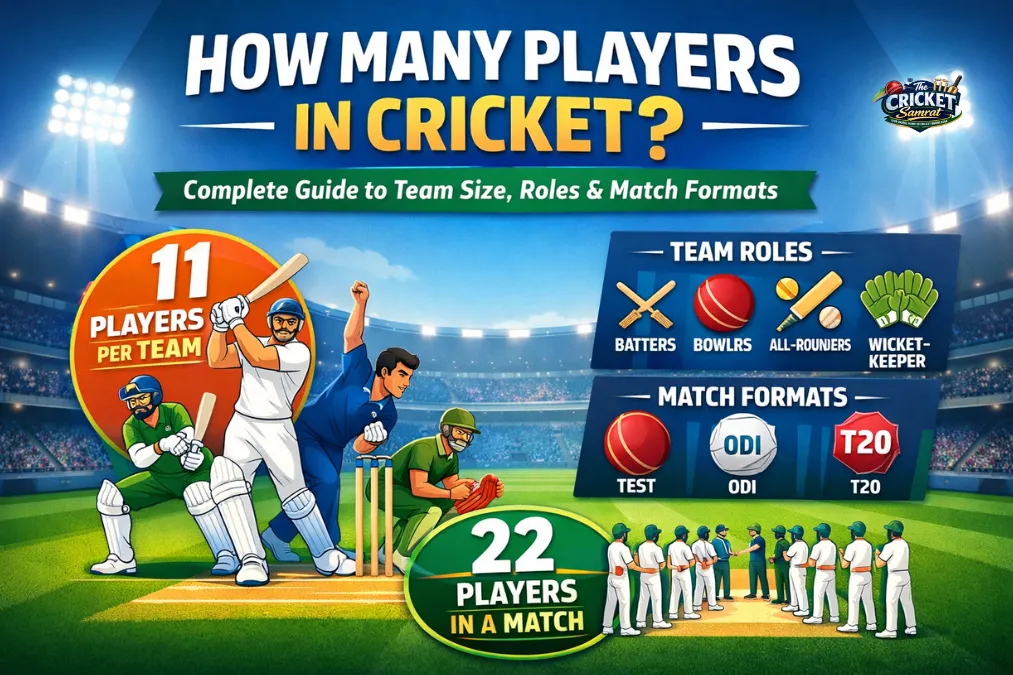
How many players in cricket is one of the most common questions asked by beginners and cricket fans across the world. Cricket may seem complicated at first, but once you clearly understand the number of players, their roles, and team structure, the game becomes very easy to follow.
Cricket is played between two teams, and each team must follow fixed rules regarding player numbers. In this detailed guide, you will learn everything about team size, player roles, formats, and official rules in simple and natural English.
How Many Players in Cricket in One Team
In official cricket rules, each team has 11 players.
This rule applies to all recognized formats of the game, including international cricket, domestic tournaments, and professional leagues.
Basic Player Structure
| Category | Number |
|---|---|
| Players in one team | 11 |
| Total players in a match | 22 |
| Batters on field at one time | 2 |
| Fielding players | 11 |
So, the direct and correct answer to how many players in cricket is 11 players per team.
Why Cricket Has 11 Players
The rule of 11 players has existed since the early history of cricket. Over time, this number proved perfect for maintaining balance between batting, bowling, and fielding.
Having 11 players allows:
Balanced field coverage
Enough bowling options
Strong batting depth
Fair competition
This is why the number has never changed in professional cricket.
Player Roles in a Cricket Team
Although there are 11 players, each one has a specific responsibility. These roles help form a strong team combination.
Main Player Roles
| Role | Purpose |
|---|---|
| Batter | Scores runs |
| Bowler | Takes wickets |
| All-rounder | Bats and bowls |
| Wicket-keeper | Keeps wickets and fields |
Each role contributes equally to the team’s success.
Batters in Cricket
Batters are responsible for scoring runs and building partnerships.
Types of Batters
| Type | Position |
|---|---|
| Opening batter | Starts the innings |
| Top-order batter | Faces new ball |
| Middle-order batter | Controls innings |
| Lower-order batter | Supports tail |
Usually, a team has 5 to 6 specialist batters.
Bowlers in Cricket
Bowlers aim to dismiss batters and control the run flow.
Types of Bowlers
| Bowling Type | Description |
|---|---|
| Fast bowler | High-speed deliveries |
| Medium pacer | Swing and accuracy |
| Spin bowler | Turn and deception |
Most teams select 4 to 5 bowlers in the playing eleven.
All-Rounders
All-rounders are players who can bat and bowl effectively.
Importance of All-Rounders
| Benefit | Explanation |
|---|---|
| Team balance | Reduces pressure |
| Extra options | More bowling choices |
| Batting depth | Longer batting lineup |
Modern cricket teams depend heavily on all-rounders.
Wicket-Keeper Role
The wicket-keeper is a specialist player who stands behind the stumps.
Responsibilities of Wicket-Keeper
| Task | Description |
|---|---|
| Catching | Edges and deflections |
| Stumping | Quick glove work |
| Run-outs | Fast throwing |
| Guidance | Helps bowlers and captain |
Every team has only one wicket-keeper in the playing XI.
How Many Players in Cricket Match Including Substitutes
Only 11 players are allowed to bat and bowl. However, teams also name substitute players.
Substitute Player Rules
| Aspect | Rule |
|---|---|
| Batting allowed | No |
| Bowling allowed | No |
| Fielding allowed | Yes (with permission) |
| Squad size | 15–18 players |
Substitutes are mainly used in case of injury.
Playing XI vs Squad
Many fans confuse squad size with actual match players.
Difference Explained
| Term | Meaning |
|---|---|
| Squad | Total selected players |
| Playing XI | Final 11 players |
| Match participation | Only XI |
Even if a squad has 18 players, only 11 can play in a match.
How Many Players in Cricket Across All Formats
The number of players remains the same in every format.
Format Comparison Table
| Format | Overs | Players Per Team |
|---|---|---|
| Test Cricket | Unlimited | 11 |
| ODI | 50 overs | 11 |
| T20 | 20 overs | 11 |
| T10 | 10 overs | 11 |
No matter the format, the answer to how many players in cricket remains unchanged.
Players on the Field During Live Play
At one moment during a match:
| Category | Number |
|---|---|
| Fielding team | 11 |
| Batting team on pitch | 2 |
| Total visible players | 13 |
The remaining batters wait in the pavilion.
Fielding Positions Covered by 11 Players
With 11 players, teams can cover the entire ground effectively.
Common Fielding Positions
| Close Field | Deep Field |
|---|---|
| Slip | Long-on |
| Gully | Long-off |
| Point | Deep cover |
| Cover | Third man |
| Mid-on | Fine leg |
Field placements depend on bowling style and match situation.
How Many Players in Cricket for School and Junior Matches
In official competitions, 11 players are compulsory. However, junior-level cricket may allow flexibility.
Junior Match Structure
| Level | Players |
|---|---|
| Professional | 11 |
| School | 9–11 |
| Practice matches | 7–10 |
The main goal at junior level is learning, not strict rules.
How Many Players in Street Cricket
Street cricket does not follow official rules.
Common Team Sizes in Street Cricket
| Area | Players |
|---|---|
| Small street | 4–5 |
| Medium ground | 6–8 |
| Open field | 10–11 |
Street cricket focuses on fun and enjoyment.
What If a Team Has Less Than 11 Players
Sometimes a team may be short of players.
Official Rules
| Situation | Result |
|---|---|
| Player injured | Match continues |
| Player absent | Team plays short |
| Replacement | Not allowed |
Missing players cannot bat or bowl.
Can Teams Change Players During a Match
Once the match starts, the playing XI cannot be changed.
Player Change Rules
| Situation | Allowed |
|---|---|
| Normal substitution | No |
| Injury replacement | Fielding only |
| Concussion substitute | Yes (ICC approved) |
Concussion substitutes must be like-for-like replacements.
How Many Players in Cricket According to ICC
The International Cricket Council governs cricket laws worldwide.
ICC Player Rules
| Rule | Description |
|---|---|
| Team size | 11 players |
| Minimum players | 11 at start |
| Batting limit | Only XI |
| Bowling limit | Only XI |
These rules ensure fairness in global cricket.
Typical Team Combination
A balanced team usually looks like this:
Standard Team Breakdown
| Role | Number |
|---|---|
| Batters | 5–6 |
| All-rounders | 1–3 |
| Bowlers | 4–5 |
| Wicket-keeper | 1 |
This combination may change depending on pitch and conditions.
Comparison With Other Sports
Team Size Comparison
| Sport | Players |
|---|---|
| Cricket | 11 |
| Football | 11 |
| Hockey | 11 |
| Basketball | 5 |
| Kabaddi | 7 |
Cricket shares its team size with football but has more specialized roles.
How Many Players in Cricket History
From the 18th century to modern times:
| Era | Team Size |
|---|---|
| Early cricket | 11 |
| Colonial era | 11 |
| Modern era | 11 |
The number has never changed in official cricket history.
Common Myths About Cricket Players
Myths vs Facts
| Myth | Reality |
|---|---|
| Only batters can bat | All players can bat |
| Bowlers cannot score | Bowlers can bat |
| Keeper cannot bat | Keeper is a batter |
Modern cricket encourages multi-skilled players.
Match Officials Along With Players
Besides players, many officials manage a match.
Match Personnel
| Role | Number |
|---|---|
| On-field umpires | 2 |
| Third umpire | 1 |
| Fourth umpire | 1 |
| Match referee | 1 |
However, only players count toward team size.
Importance of Knowing Player Numbers
Understanding how many players in cricket helps fans:
Follow scorecards easily
Understand team strategy
Enjoy commentary
Learn rules faster
It is the foundation of cricket knowledge.
Also read: Who Is the God of Cricket: Meaning, History, and the Legend Behind the Title
Conclusion: on How Many Players in Cricket
Cricket is a game built on balance, tradition, and teamwork. The rule of 11 players per team has stood strong for hundreds of years and continues to define the structure of the sport.
To summarize clearly:
| Key Point | Answer |
|---|---|
| Players per team | 11 |
| Total players in match | 22 |
| Formats | All same |
| ICC rule | Mandatory |
Whether you are a beginner, student, or lifelong fan, understanding how many players in cricket gives you complete clarity about the game. No matter how the formats evolve, the heart of cricket remains the same with 11 players fighting together as one team.