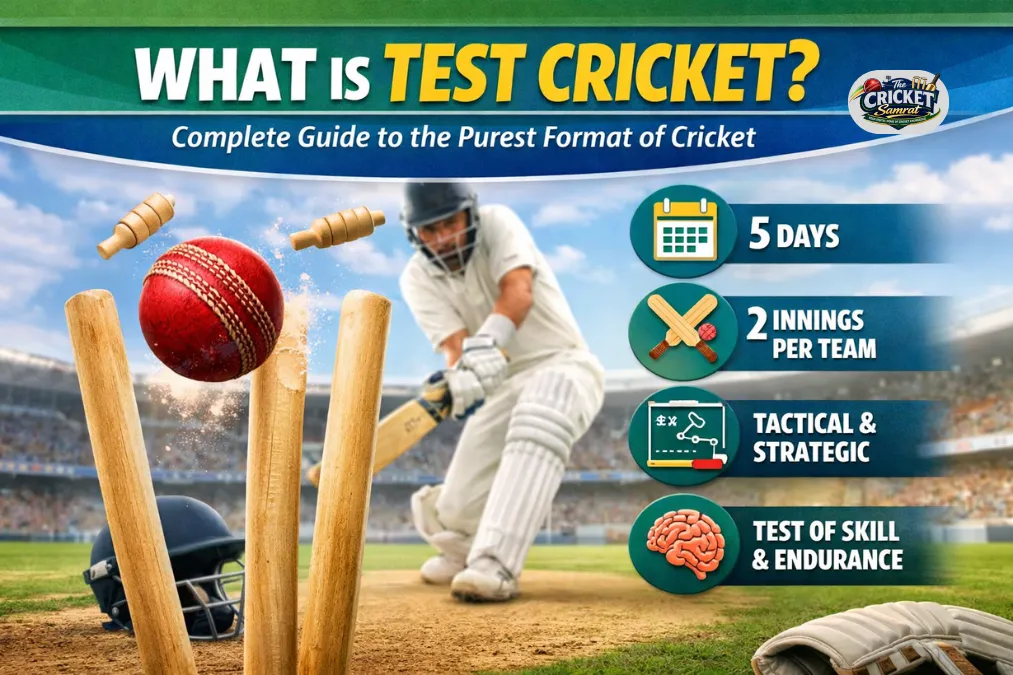
What is Test cricket is one of the most common questions asked by new cricket fans who want to understand the traditional form of the game. Test cricket is the oldest and longest format of cricket, played between two international teams over a maximum of five days. It is widely known as the purest form of cricket because it tests a player’s skill, patience, fitness, and mental strength more than any other format.
Unlike modern short formats, Test cricket focuses on technique, strategy, and endurance rather than quick entertainment. It represents the true spirit and history of the game.
What Is Test Cricket?
What is Test cricket can be explained simply as an international cricket match played over five days, where each team gets two innings to bat and bowl. The team that scores more total runs after both innings wins the match.
Test cricket is played with a red ball, players wear white clothing, and matches are held during daytime or as day-night Tests under lights.
It is considered the highest standard of cricket because success in Test matches requires consistency across different pitches, weather conditions, and countries.
History and Origin of Test Cricket
To understand what is Test cricket, it is important to know how it started.
The first official Test match was played in 1877 between England and Australia at the Melbourne Cricket Ground. The term “Test” was used because the match tested the skills and endurance of players over many days.
Over time, more nations joined international cricket, and Test matches became the foundation of the sport.
Important Milestones in Test Cricket History
| Year | Event |
|---|---|
| 1877 | First Test match played |
| 1882 | The Ashes rivalry began |
| 1932 | India played its first Test |
| 1970 | First official Test series with TV coverage |
| 2019 | World Test Championship introduced |
Test cricket has continued to evolve while maintaining its traditional values.
Duration and Match Structure
A major part of understanding what is Test cricket lies in knowing how long and how it is played.
A Test match lasts up to five days. Each day includes around 90 overs, divided into three sessions.
Structure of a Test Match
| Feature | Details |
|---|---|
| Maximum duration | 5 days |
| Innings per team | 2 |
| Overs per day | About 90 |
| Ball used | Red ball |
| Result types | Win, loss, draw, tie |
There is no limit on overs per innings, which makes time management and stamina extremely important.
Basic Rules of Test Cricket
The basic laws of cricket apply to Test matches, but some rules are unique to this format.
A team’s innings ends when ten wickets fall or the captain declares the innings closed. Bowlers can bowl unlimited overs, and fielders must maintain concentration for long periods.
If neither team wins within five days, the match ends in a draw, which is a normal and respected result in Test cricket.
What Makes Test Cricket Unique
When people ask what is Test cricket, the real answer lies in its uniqueness.
Test cricket is not about scoring fast runs. It is about building innings, wearing down bowlers, and adapting to changing conditions.
The match situation can change dramatically over five days. A team dominating on day one can struggle on day four due to pitch deterioration or weather changes.
This unpredictability is what makes Test cricket special.
Importance of Technique in Test Cricket
Technique is the backbone of Test cricket.
Batters must defend well, leave unnecessary deliveries, and play late with soft hands. Bowlers focus on line, length, movement, and patience.
Unlike limited-overs cricket, risky shots are discouraged. Survival is as important as scoring.
Strong technique allows players to succeed in different countries and pitch conditions.
Role of Pitch and Weather Conditions
Another key element in understanding what is Test cricket is pitch behavior.
Test pitches change over time, unlike limited-overs pitches that remain similar throughout the match.
Pitch Behavior Over Five Days
| Day | Typical Condition |
|---|---|
| Day 1 | Hard surface, good for batting |
| Day 2 | Balanced for bat and ball |
| Day 3 | Best time for batting |
| Day 4 | Cracks appear, spin increases |
| Day 5 | Uneven bounce, difficult batting |
Weather such as cloud cover, rain, and heat also has a major impact on swing, seam, and player fitness.
Scoring System in Test Cricket
Runs are scored the same way as other formats, but scoring in Test cricket is much more demanding.
Batters often face hundreds of deliveries to build an innings.
Common Batting Milestones
| Runs | Achievement |
|---|---|
| 50 | Half-century |
| 100 | Century |
| 200 | Double century |
| 300 | Triple century |
A Test century is considered one of the greatest achievements in cricket.
Test-Playing Nations
Currently, twelve teams have full Test status granted by the International Cricket Council.
List of Test Cricket Teams
| Country | Test Debut Year |
|---|---|
| England | 1877 |
| Australia | 1877 |
| South Africa | 1889 |
| West Indies | 1928 |
| New Zealand | 1930 |
| India | 1932 |
| Pakistan | 1952 |
| Sri Lanka | 1982 |
| Zimbabwe | 1992 |
| Bangladesh | 2000 |
| Ireland | 2018 |
| Afghanistan | 2018 |
Each nation has its own playing style shaped by local conditions.
Legendary Test Cricket Players
Many of cricket’s greatest legends built their reputation through Test cricket.
Some All-Time Great Test Cricketers
| Player | Country | Special Achievement |
|---|---|---|
| Don Bradman | Australia | Average 99.94 |
| Sachin Tendulkar | India | 15,921 Test runs |
| Jacques Kallis | South Africa | Over 10,000 runs and 250 wickets |
| Muttiah Muralitharan | Sri Lanka | 800 Test wickets |
| Rahul Dravid | India | Known as “The Wall” |
| Shane Warne | Australia | Legendary leg-spinner |
These players succeeded across conditions and eras.
Mental Strength in Test Cricket
Test cricket is often described as a mental battle.
Batters may bat for six to eight hours. Bowlers may deliver long spells without immediate success. Fielders must stay alert despite fatigue.
Mental discipline separates great Test cricketers from average ones.
Comparison With Other Cricket Formats
To better understand what is Test cricket, it helps to compare it with other formats.
Test vs ODI vs T20
| Format | Duration | Overs | Style |
|---|---|---|---|
| Test | Up to 5 days | Unlimited | Technique and endurance |
| ODI | One day | 50 overs | Balanced approach |
| T20 | About 3 hours | 20 overs | Aggressive and fast |
Each format has its value, but Test cricket remains the most challenging.
Declaration in Test Cricket
Declaration is a tactical decision taken by the captain to end the innings early.
It is used to save time and give bowlers enough overs to dismiss the opposition.
Declarations add strategic depth and make captaincy very important in Test cricket.
Draws and Their Meaning
Many fans misunderstand draws.
In Test cricket, a draw often reflects strong defense, weather interruption, or closely fought competition.
Some of the greatest matches in history have ended in memorable draws that showcased extraordinary skill and courage.
Fielding in Test Cricket
Fielding in Test cricket is physically demanding.
Players may remain on the field for over 100 overs in a single day. Reflex catching, close-in fielding, and endurance are essential.
A single dropped catch can change the outcome of a five-day match.
Importance of Teamwork
Test cricket cannot be won by one player alone.
Partnerships, disciplined bowling spells, smart field placements, and lower-order contributions all play vital roles.
Every run and every wicket matters.
World Test Championship
The World Test Championship was introduced to add global context to Test cricket.
Teams earn points based on series results, and the top two teams qualify for the final.
This system has increased competitiveness and interest in bilateral Test series.
Why Test Cricket Is the Ultimate Format
Test cricket examines every cricketing skill.
Players must perform on fast pitches, turning tracks, swinging conditions, and under pressure situations.
Only those with discipline, adaptability, and determination succeed consistently.
Also read: What Is Cricket? Complete Guide to the Game, Rules, History, and Formats
Famous Test Cricket Series
Some series define the legacy of Test cricket.
The Ashes between England and Australia is the oldest rivalry.
India vs Australia has become one of the toughest modern contests.
India vs England and South Africa vs Australia are also highly competitive Test series.
Challenges Facing Test Cricket
Despite its prestige, Test cricket faces challenges from busy schedules and the popularity of T20 leagues.
However, strong fan support, historic rivalries, and championship formats continue to protect its importance.
Future of Test Cricket
With innovations like day-night Tests and better scheduling, Test cricket is adapting to modern audiences.
As long as the spirit of competition remains, Test cricket will continue to thrive.
Also read: India National Cricket Team: History, Achievements, Players, Records, and Global Impact
Conclusion
What is Test cricket is not just a question about match length or rules. Test cricket represents patience, discipline, strategy, and tradition. It is the format where true cricketers are tested and legends are born.
In an era of fast entertainment, Test cricket stands tall as the ultimate examination of skill and character, preserving the soul of the game for generations to come.