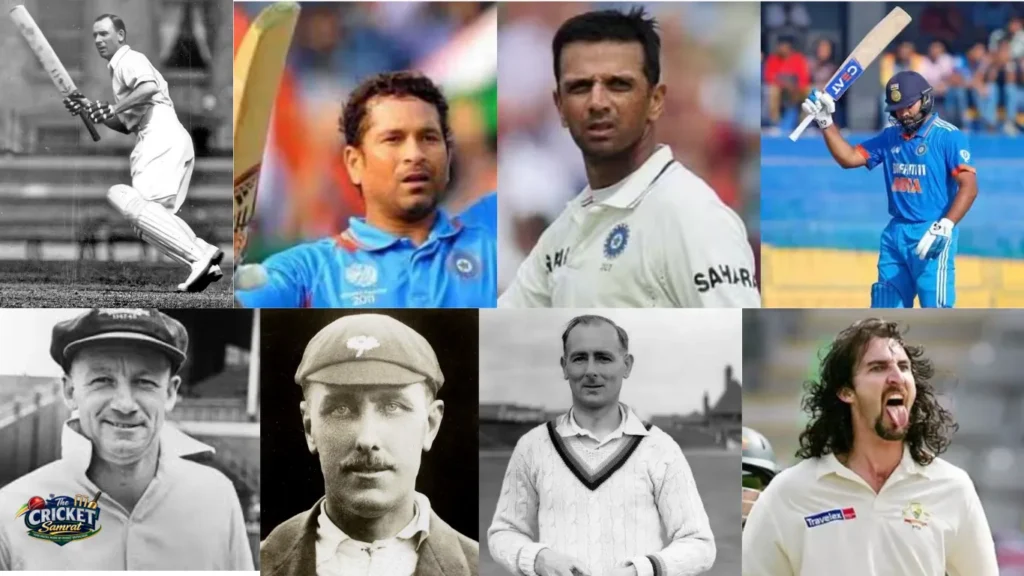
11 Unbreakable Records in Cricket History: Cricket is a sport built on numbers, milestones, and moments that define generations. Records are created in almost every series, broken by new stars, and rewritten by changing formats and faster playing styles. Yet, amid this constant evolution, a rare group of achievements stands tall-records so extraordinary that even in today’s high-scoring, technology-driven era, they appear virtually impossible to surpass.
From monumental batting feats to unbelievable bowling spells and unmatched consistency over decades, these achievements belong to legends whose names are etched permanently into the game’s history. The rise of T20 leagues, player workload management, shortened careers, and changing strategies have made certain milestones unreachable.
This in-depth feature explores 11 Unbreakable Records in Cricket History, achievements that have resisted time, technology, and generations of elite players. These records are not just statistics; they are stories of endurance, discipline, brilliance, and moments when human skill reached its absolute peak.
Cricket and the Concept of “Unbreakable” Records
Modern cricket is vastly different from what it was even 20 years ago. Schedules are packed, players specialize in formats, and long careers spanning over two decades are now rare. As a result, records built on longevity, patience, and traditional formats face extinction.
While some milestones may still fall, others require a combination of talent, opportunity, era-specific conditions, and extraordinary mental strength-factors unlikely to align again.
Here are the 11 Unbreakable Records in Cricket History that define greatness beyond numbers.
1. Sachin Tendulkar’s 100 International Centuries (India)
Sachin Tendulkar’s name is synonymous with cricket itself. Revered globally as the “God of Cricket,” Tendulkar remains the only player in history to score 100 international centuries, a record that has stood untouched for over a decade.
Why This Record Is Nearly Impossible to Break
- Tendulkar played international cricket for 24 years
- He scored 51 Test centuries and 49 ODI centuries
- He maintained consistency across formats, eras, bowlers, and continents
His first international century came in 1990 against England, and his final one in 2012 against Bangladesh. In between, he faced generations of fast bowlers, evolving pitches, and immense pressure from a cricket-obsessed nation.
Modern players rarely play all formats consistently for over 15 years. With workload management, injuries, and franchise cricket priorities, the chances of any cricketer even reaching 80 international centuries seem remote-making Tendulkar’s 100 one of the most secure records in cricket history.
2. Rahul Dravid Never Getting Out for a Golden Duck in Tests (India)
Rahul Dravid, famously known as “The Wall,” built his legacy on patience, discipline, and technical perfection. Among his many remarkable achievements lies a record that often goes unnoticed yet remains astonishing.
Across 286 Test innings, Dravid was never dismissed for a golden duck-never out on the very first ball he faced.
Why It’s Unlikely to Be Broken
- Test cricket exposes batsmen to the toughest conditions
- Opening spells from fast bowlers are the most dangerous
- Even the greatest players occasionally fall early
Dravid played 164 Test matches, scoring 13,288 runs at an average of 52.31, including 36 centuries. Maintaining such consistency without ever being dismissed on the first ball reflects extraordinary concentration and technique-qualities rarely sustained across such a long career.
3. Brian Lara’s 400* in a Test Innings (West Indies)
In 2004, at Antigua, Brian Lara delivered one of the most iconic performances in cricket history. Facing England, the West Indies legend scored an unbeaten 400 runs in a single Test innings, reclaiming the record for the highest individual Test score.
Why This Record Stands Alone
- Lara remains the only player to score 400 in a Test
- He faced 582 deliveries over nearly 13 hours
- Modern declarations, time constraints, and aggressive tactics make such innings unlikely
In today’s game, captains prioritize match results over individual milestones. Batting for such extended periods is rare, and opportunities to reach such heights are even rarer.
4. Wiaan Mulder’s Selfless Declaration Near 400 (South Africa)
While not surpassing Lara, South African all-rounder Wiaan Mulder earned global respect for a rare moment of sportsmanship. After scoring an unbeaten 367, Mulder chose to declare the innings early, deliberately preserving Brian Lara’s iconic record.
Why This Moment Is Historic
- Mulder was within touching distance of 400
- He sacrificed personal glory out of respect for a legend
- Such gestures are rare in elite sport
While Mulder’s innings showcased immense talent, his decision reinforced why Lara’s record remains protected not only by difficulty-but by reverence.
5. Rohit Sharma’s 264 in One-Day Internationals (India)
On November 13, 2014, at Eden Gardens, Rohit Sharma rewrote ODI history by scoring 264 runs, the highest individual score ever recorded in a one-day match.
What Makes This Record Unbreakable
- Rohit struck 33 fours and 9 sixes in just 173 balls
- He is the only player with three ODI double centuries
- No other batsman has more than one ODI double hundred
In an era of aggressive batting, one might assume such scores are attainable. Yet, consistency, endurance, and strike rotation required to reach 264 remain unmatched.
6. Muttiah Muralitharan’s 800 Test Wickets (Sri Lanka)
Sri Lanka’s legendary off-spinner Muttiah Muralitharan is the most prolific wicket-taker in Test cricket history, claiming 800 wickets in just 133 matches.
Why This Record Is Almost Untouchable
- Modern bowlers play fewer Test matches
- Workload management limits long careers
- Few bowlers dominate across all conditions like Murali did
In addition to his Test record, Muralitharan also holds the record for most ODI wickets (534) and most 10-wicket hauls in Tests (22). His longevity, variation, and mental toughness created a legacy that modern cricket may never replicate.
7. Sir Jack Hobbs’ 199 First-Class Centuries (England)
Sir Jack Hobbs was a run-scoring machine in the early 20th century. Over a remarkable first-class career spanning nearly three decades, he scored 199 centuries, a record that still stands today.
Why It’s Unbreakable Today
- Hobbs played 834 first-class matches
- Modern players play far fewer red-ball games
- Domestic cricket calendars have shrunk globally
Despite advancements in fitness and equipment, no modern batter has come close to matching Hobbs’ sheer volume of centuries.
8. Sir Donald Bradman’s Test Average of 99.94 (Australia)
Perhaps the most famous statistic in all of sport, Sir Donald Bradman’s career Test batting average of 99.94 remains unmatched and almost unimaginable.
Why This Record Is Legendary
- Bradman played 52 Tests, scoring 6,996 runs
- His average is nearly 40 runs higher than modern greats
- Even one additional run in his final innings would have given him a perfect 100
In modern cricket, averages above 50 are considered elite. Bradman’s dominance belongs to an entirely different realm.
9. Wilfred Rhodes’ Test Appearance at 52 Years of Age (England)
Wilfred Rhodes holds the record for being the oldest player to appear in a Test match, playing for England at 52 years and 165 days in 1930.
Why This Record Will Stand
- Modern fitness standards limit longevity
- International cricket demands peak athleticism
- Players rarely compete past their early 40s
Rhodes’ adaptability—from lower-order batsman to opening batsman-adds to the uniqueness of his career.
Read also: Joe Root Test Centuries Explained: A Journey of Consistency, Class, and Records
10. Hedley Verity’s 10 Wickets for 10 Runs (England)
In 1932, English left-arm spinner Hedley Verity delivered a spell that defies belief. Playing for Yorkshire, he took 10 wickets for just 10 runs in a first-class match against Nottinghamshire.
Why This Bowling Feat Is Unmatched
- He bowled 16 maiden overs in 19.4 overs
- Claimed seven wickets in just 15 balls
- Achieved a hat-trick within the spell
In modern cricket, with heavier bats, flatter pitches, and aggressive batting, such figures are virtually impossible.
Read also: Longest Six in Cricket History: A Complete and Honest Exploration
11. Jason Gillespie’s 201* as a Nightwatchman (Australia)
Former Australian fast bowler Jason Gillespie produced one of the most astonishing batting performances in Test history. Playing as a nightwatchman against Bangladesh in 2006, he scored an unbeaten 201.
Why This Record Is Unique
- Highest score ever by a nightwatchman
- Achieved a double century in the second innings
- Shared a 320-run partnership with Michael Hussey
Nightwatchmen are selected to survive, not dominate. Gillespie’s innings stands as a once-in-a-lifetime anomaly.
Read also: Who Is the Best Captain in Cricket History: A Complete and Honest Analysis
Why These Records May Never Be Broken
Cricket has changed. Careers are shorter, formats are specialized, and priorities have shifted. The game now rewards speed, innovation, and entertainment—but often at the cost of longevity and traditional excellence.
The 11 Unbreakable Records in Cricket History reflect an era when patience, endurance, and consistency defined greatness. While future stars will continue to break records, these milestones are protected by time, circumstance, and the extraordinary individuals who achieved them.
Conclusion
Records are meant to inspire, but some exist to remind us that certain moments belong exclusively to history. These legendary achievements are not just numbers-they are stories of human limits being pushed beyond imagination.
As cricket continues to evolve, these records will stand as timeless benchmarks, reminding fans why the game’s past remains as powerful as its future.