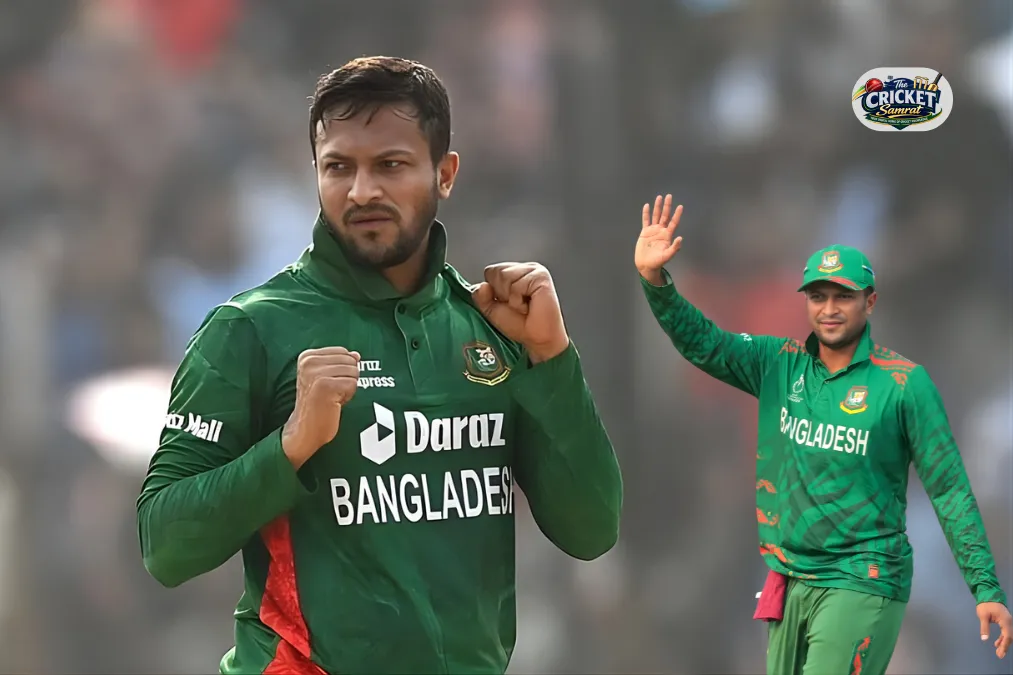
Shakib Al Hasan: The Bangladesh Cricket Board (BCB) has officially reopened the possibility of a national team return for legendary all-rounder Shakib Al Hasan, marking a dramatic potential comeback for one of the most influential cricketers in the country’s history. The move comes months after Shakib announced his retirement from international cricket in 2024, a decision he has since publicly reconsidered.
Shakib Al Hasan’s possible return is unfolding against a backdrop of political turbulence, public controversy, and sporting uncertainty for Bangladesh cricket. Once revered almost universally for his performances on the field, Shakib’s dual role as a former lawmaker in the ousted ruling party placed him at the centre of national debate following the 2024 uprising that reshaped Bangladesh’s political landscape.
Despite the controversy, Bangladesh cricket authorities have now confirmed that the door remains open—provided certain conditions are met.
BCB Confirms Willingness to Consider Shakib Al Hasan
Senior Bangladesh Cricket Board official Amzad Hossain confirmed late Saturday that the board had taken a unanimous decision to consider Shakib Al Hasan for selection if he is available, fit, and able to physically attend matches.
“The board has taken a unanimous decision that if Shakib Al Hasan’s availability, fitness, and accessibility allow it, and if he can be present at the venue where matches are played, then the board and the selection panel will consider him for the national team,” Hossain told reporters.
This statement represents the clearest signal yet that Bangladesh cricket’s governing body is willing to separate on-field excellence from off-field controversy, at least from a selection standpoint.
The announcement immediately reignited debate among fans, analysts, and former players about whether Shakib’s experience could help stabilise a national side currently facing one of its most challenging periods in recent memory.
From Retirement to Reconsideration
Shakib Al Hasan announced his retirement from international cricket in 2024, citing personal reasons and the growing pressures of balancing professional sport with political and public responsibilities. At the time, many observers believed the decision marked the end of an era for Bangladesh cricket.
However, last month, Shakib publicly stated that he would like to reverse his retirement, suggesting unfinished business with the national team. That statement prompted quiet discussions within the BCB, which have now culminated in the official reopening of his selection prospects.
Cricket insiders say the board’s willingness to consider Shakib reflects both his exceptional record and the current shortage of experienced match-winners in the squad.
A Career That Defined Bangladesh Cricket
Few players in world cricket have carried the weight of a nation’s expectations like Shakib Al Hasan. Since making his international debut in 2006, the left-arm all-rounder has been the heartbeat of Bangladesh’s rise from underdogs to competitive opponents across formats.
Shakib Al Hasan – International Career Overview
| Format | Matches Played | Wickets Taken | Batting & Bowling Impact |
|---|---|---|---|
| Test Matches | 71 | — | Key contributor with bat and ball |
| One-Day Internationals (ODIs) | 247 | — | One of the most consistent all-rounders in ODI history |
| Twenty20 Internationals (T20Is) | 129 | — | Match-winner in global tournaments |
| Total Wickets (All Formats) | — | 712 | Among the world’s most prolific all-rounders |
Shakib’s combined 712 international wickets underline his value as a bowler, while his batting contributions—often under pressure—have won Bangladesh numerous matches against higher-ranked teams.
For more than a decade, Shakib consistently topped ICC all-rounder rankings, becoming a global symbol of Bangladesh cricket’s credibility on the world stage.
Political Turmoil and Public Backlash
While Shakib Al Hasan’s cricketing achievements are beyond dispute, his political involvement complicated his standing at home. As a lawmaker aligned with former prime minister Sheikh Hasina, Shakib found himself in a difficult position during the student-led uprising that ultimately overthrew the government in 2024.
Following the violent police crackdown on protesters, public anger surged, and Shakib became one of several high-profile figures facing murder investigations linked to the unrest. Although he has not been convicted of any wrongdoing, the allegations significantly damaged his public image.
Shakib later apologised for remaining silent during the protests, acknowledging public disappointment while defending his decision to serve the government at the time.
His absence from Bangladesh since the collapse of the Hasina administration has further fuelled speculation about his future both on and off the field.
Playing Abroad While Bangladesh Changed
When Bangladesh’s political crisis reached its peak, Shakib Al Hasan was not in the country. He was participating in a domestic Twenty20 competition in Canada, continuing his playing career away from the immediate fallout of the uprising.
Since then, he has not returned to Bangladesh, raising questions about his ability to meet the BCB’s requirement of being physically present at match venues if selected.
However, cricket administrators appear willing to accommodate logistical challenges, provided Shakib demonstrates commitment and readiness to represent the national side again.
BCB to Issue No-Objection Certificates
In another significant move, the Bangladesh Cricket Board confirmed it would issue No-Objection Certificates (NOCs) allowing Shakib Al Hasan to participate in overseas leagues.
“If he wants to participate in other global tournaments, the board will provide him NOC as required,” Amzad Hossain said.
This decision suggests the board is keen to maintain a functional relationship with Shakib, recognising that regular competitive cricket abroad could help him maintain fitness and form.
Overseas Leagues and Opportunities
| League Type | Potential Benefit for Shakib Al Hasan |
|---|---|
| Franchise T20 Leagues | Match fitness and global exposure |
| Domestic Leagues Abroad | Reduced political pressure |
| International Tournaments | Pathway back to national selection |
The move also signals a more flexible approach from the BCB at a time when Bangladesh cricket is struggling to retain its international relevance.
Bangladesh Cricket in Crisis
Shakib Al Hasan’s possible return comes as Bangladesh cricket faces one of its most turbulent periods. The national team was removed from next month’s T20 World Cup, with the International Cricket Council (ICC) replacing Bangladesh with Scotland.
The decision followed the BCB’s refusal to send its players to India, citing security concerns, and its request for matches to be shifted to co-host Sri Lanka.
The ICC stated that it found no credible security threat to Bangladesh players in India, a conclusion that clashed sharply with the BCB’s position.
“This is a government decision taken on security grounds,” Amzad Hossain explained. “Because of that, there was nothing more we could do.”
Diplomatic Tensions Spill Into Cricket
The dispute escalated earlier this month when the Indian cricket board ordered Indian Premier League franchise Kolkata Knight Riders to release Bangladesh fast bowler Mustafizur Rahman.
The decision further strained cricketing ties between New Delhi and Dhaka, highlighting how geopolitical tensions are increasingly influencing sporting decisions in the region.
For Bangladesh, exclusion from the T20 World Cup represents not only a sporting setback but also a financial and reputational blow—making the potential return of a global star like Shakib Al Hasan even more significant.
Can Shakib Al Hasan Still Make a Difference?
At 37, questions naturally arise about whether Shakib Al Hasan can still perform at the highest level. Yet his recent performances in domestic and franchise cricket suggest he remains a formidable all-rounder.
Key Factors in Shakib’s Potential Return
| Factor | Status |
|---|---|
| Physical Fitness | Under assessment |
| Match Readiness | Actively playing abroad |
| Availability | Dependent on travel and clearance |
| Selection Approval | Open from BCB and selectors |
Former players and analysts argue that Shakib’s experience could be invaluable, particularly for a young Bangladesh squad lacking leadership and composure in high-pressure situations.
Public Opinion Remains Divided
While many fans welcome the possibility of seeing Shakib Al Hasan in national colours again, others remain critical of his political past. Social media reactions have been mixed, reflecting broader national divisions that extend beyond cricket.
Some supporters believe sport should remain separate from politics, while critics argue that public figures must be held accountable regardless of their professional achievements.
The BCB, however, appears focused on performance and stability, prioritising cricketing considerations during a period of institutional uncertainty.
What Happens Next?
For now, Shakib Al Hasan’s return remains conditional rather than guaranteed. The selection panel will assess his fitness, availability, and willingness to re-engage fully with the national setup.
If those conditions are met, Bangladesh cricket could soon witness one of its most dramatic comebacks—an experienced all-rounder returning at a time when the team desperately needs direction.
Whether Shakib’s comeback ultimately unites or further divides fans, one thing is certain: his name continues to shape the narrative of Bangladesh cricket, even after retirement.
Also read: ICC Warns Pakistan Over Bangladesh Support, Asia Cup Exclusion and Sanctions Loom
Conclusion
The Bangladesh Cricket Board’s decision to reopen the door for Shakib Al Hasan underscores the complex intersection of sport, politics, and national identity in modern Bangladesh. As the country navigates political change and cricketing uncertainty, the potential return of its greatest all-rounder offers both hope and controversy.
If Shakib does make a comeback, it will not simply be another selection—it will be a defining moment for Bangladesh cricket, testing its ability to balance legacy, accountability, and the pursuit of excellence on the international stage.