What is a diamond duck in cricket is a common question among cricket fans when they notice a batter getting out without facing even a single ball. Cricket has many unique terms, and diamond duck is one of the rarest and most unfortunate dismissals in the game.
This type of dismissal is unusual because the batter does not get a chance to play any delivery. Despite that, the player is still recorded as out in the scorecard.
In this article, you will clearly understand what a diamond duck in cricket is, how it happens, how it is different from other ducks, famous examples, rules, and why it is considered extremely unlucky.
What Is a Diamond Duck in Cricket?
What is a diamond duck in cricket?
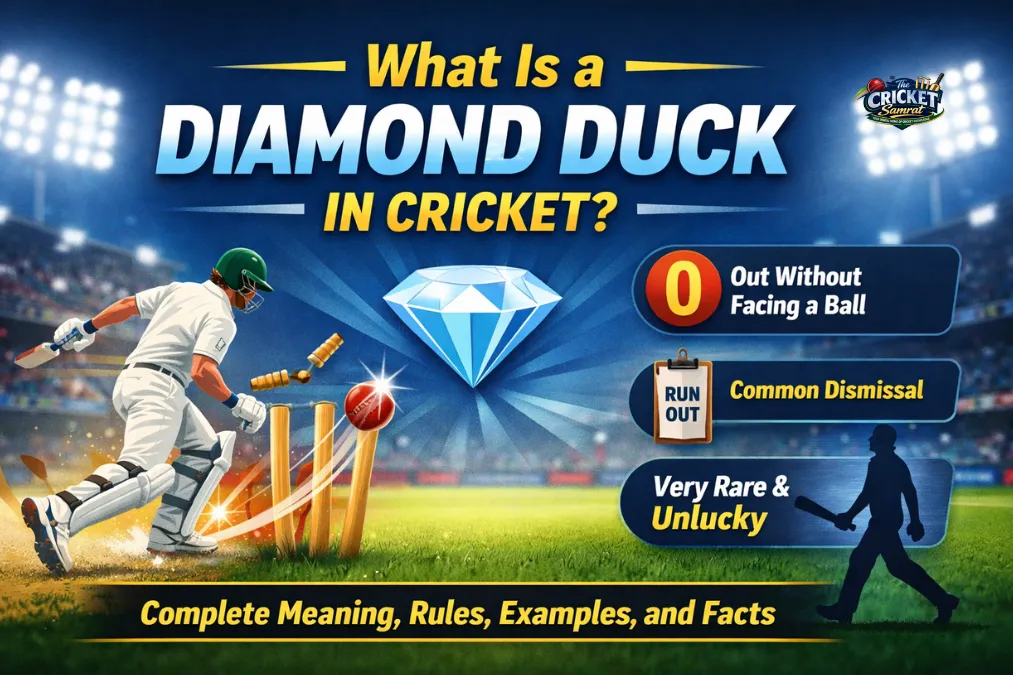
A diamond duck occurs when a batter is dismissed without facing a single legal delivery.
This means:
- Zero runs scored
- Zero balls faced
- Batter still counted as out
The dismissal usually happens due to a run-out or another rare form of dismissal before the batter gets the chance to face the first ball.
Why Is It Called a Diamond Duck?
The word “diamond” is used because this type of duck is extremely rare.
Just like diamonds are rare and valuable, diamond ducks are uncommon in cricket matches. Many professional cricketers complete their entire careers without ever experiencing one.
Types of Ducks in Cricket
To understand what is a diamond duck in cricket, it is important to compare it with other types of ducks.
Different Types of Ducks Table
| Type of Duck | Meaning |
|---|---|
| Golden Duck | Out on the first ball faced |
| Silver Duck | Out on the second ball faced |
| Bronze Duck | Out on the third ball faced |
| Platinum Duck | Out on the first ball of the innings |
| Diamond Duck | Out without facing any ball |
Among all these, the diamond duck is the rarest.
How Does a Diamond Duck Happen?
A diamond duck can occur in several ways. The most common reasons are explained below.
Common Diamond Duck Dismissal Methods
| Method | Explanation |
|---|---|
| Run Out | Batter is run out at non-striker’s end before facing a ball |
| Timed Out | Batter fails to arrive at crease within allowed time |
| Obstructing the Field | Batter illegally blocks fielders |
| Handling the Ball | Extremely rare method under old rules |
Among these, run-out is responsible for most diamond ducks in cricket history.
Run Out Without Facing a Ball
This is the most frequent situation.
A new batter arrives at the non-striker’s end and attempts a quick single. If there is miscommunication and the fielder hits the stumps before the batter reaches the crease, the batter is dismissed without facing a delivery.
This immediately results in a diamond duck.
How Is a Diamond Duck Shown on the Scorecard?
On the official scorecard, a diamond duck appears as:
| Runs | Balls Faced | Dismissal |
|---|---|---|
| 0 | 0 | Run Out / Timed Out |
This is what separates it from a golden duck, which shows one ball faced.
Difference Between Diamond Duck and Golden Duck
Many fans confuse these two terms.
Diamond Duck vs Golden Duck Table
| Point | Diamond Duck | Golden Duck |
|---|---|---|
| Balls Faced | 0 | 1 |
| Runs | 0 | 0 |
| Bowler Gets Wicket | No | Yes |
| Rarity | Very rare | Common |
| Method | Mostly run out | Any dismissal |
This makes the diamond duck far more unfortunate.
Diamond Duck in Different Cricket Formats
Occurrence by Format
| Format | Frequency |
|---|---|
| Test Cricket | Extremely rare |
| ODI Cricket | Rare |
| T20 Cricket | More common due to quick running |
T20 cricket sees more diamond ducks because batters take higher risks.
Famous Diamond Ducks in Cricket History
Many legendary players have suffered diamond ducks, proving that luck plays a huge role in cricket.
Famous Players with Diamond Ducks
| Player | Team |
|---|---|
| Sachin Tendulkar | India |
| Inzamam-ul-Haq | Pakistan |
| Steve Waugh | Australia |
| Mohammad Azharuddin | India |
| Andrew Flintoff | England |
These incidents shocked fans because the players never even faced a ball.
Does the Bowler Get Credit for a Diamond Duck?
No.
Since no ball is delivered to the batter, the wicket does not go into the bowler’s statistics. It is recorded only as a team dismissal.
Does a Diamond Duck Affect Batting Average?
Yes.
Even though the batter does not face a ball, the innings is counted as:
- One dismissal
- Zero runs
This negatively affects the batting average, which is why players dislike diamond ducks so much.
Diamond Duck in Test Match Statistics
In Test cricket, diamond ducks are extremely uncommon due to careful batting and fewer risky runs.
When it does happen, it becomes a memorable moment and is often discussed for years.
Psychological Impact of a Diamond Duck
A diamond duck can affect a player mentally because:
- The batter waits long to bat
- Gets no chance to settle
- Returns to pavilion immediately
For middle-order players, it can be especially frustrating.
Impact on Team Momentum
A diamond duck can suddenly increase pressure on the batting side.
- One wicket falls without using a ball
- New batter must face immediately
- Partnership breaks instantly
In close matches, this can completely shift momentum.
Can a Diamond Duck Be Avoided?
While luck plays a role, teams can reduce risk by:
- Clear communication between batters
- Avoiding risky singles early
- Awareness of fielder positions
- Quick decision-making
Most diamond ducks happen due to confusion rather than poor skill.
Diamond Duck vs Pair and King Pair
| Term | Meaning |
|---|---|
| Pair | Two ducks in a Test match |
| King Pair | Golden duck in both innings |
| Diamond Duck Pair | Extremely rare, no official term |
A diamond duck in both innings is considered the worst luck possible.
Also read: How Many Players in Cricket: Complete Guide to Team Size, Roles, and Match Formats
Why Fans Find Diamond Ducks Interesting
Fans love diamond ducks because they are:
- Unexpected
- Rare
- Dramatic
- Match-changing
Commentators often highlight them because they reflect cricket’s unpredictable nature.
What Is a Diamond Duck in Cricket for Beginners?
For new cricket fans, understanding what is a diamond duck in cricket helps explain how a batter can be out without playing a ball.
It is one of the most unusual yet fascinating rules in the sport.
Also read: Who Is the God of Cricket: Meaning, History, and the Legend Behind the Title
Conclusion: on What Is a Diamond Duck in Cricket
Now you clearly understand what is a diamond duck in cricket, how it happens, why it is rare, and why it is considered the unluckiest dismissal in the game.
A diamond duck is not about poor batting or lack of skill. It is purely a moment of misfortune that highlights how unpredictable cricket can be.
Even the greatest players in history have fallen victim to it, proving once again that in cricket, anything can happen at any moment.